ENERGY FROM THE WATER 2025
Installed capacity
Information based on provisional data from January, 2026
Hydroelectric power is the third-largest renewable source on the Peninsula, coming in after wind power and solar photovoltaic.
Hydroelectric power traditionally was the main renewable source in Spain, until it was overtaken by wind power in 2009 and by solar photovoltaic in 2022. It remains the third-largest renewable source in terms of installed capacity, with a total of 17,077 MW at the end of 2025. As can be observed, its capacity has remained practically unchanged; it would be necessary to go back to 2012 to find an increase of over 1%. In 2025, there was a slight decrease of 0.1% compared to 2024. Hydro represents 12.3% of the total electricity generation installed capacity, therefore ranking as the fourth technology behind solar photovoltaic, wind power, and combined cycle.
Annual evolution of installed hydroelectric capacity
By autonomous community, Castilla y León is the community with the highest hydroelectric installed capacity, with 25.7% of the total national capacity, given that this region is the exclusive home of the Duero basin, the second largest in the Iberian Peninsula. It is followed by Galicia with 21.8% of the national total, bringing together a large part of the northern area, which is the largest in terms of installed capacity and also includes Asturias, Cantabria and part of País Vasco.
Five communities account for almost 80% of the total national installed capacity, including, in addition to those mentioned above, Extremadura, Cataluña, and Aragón.
Installed hydropower capacity at December 31, 2025
Geographical distribution of hydropower facilities on the peninsula at December 31, 2025
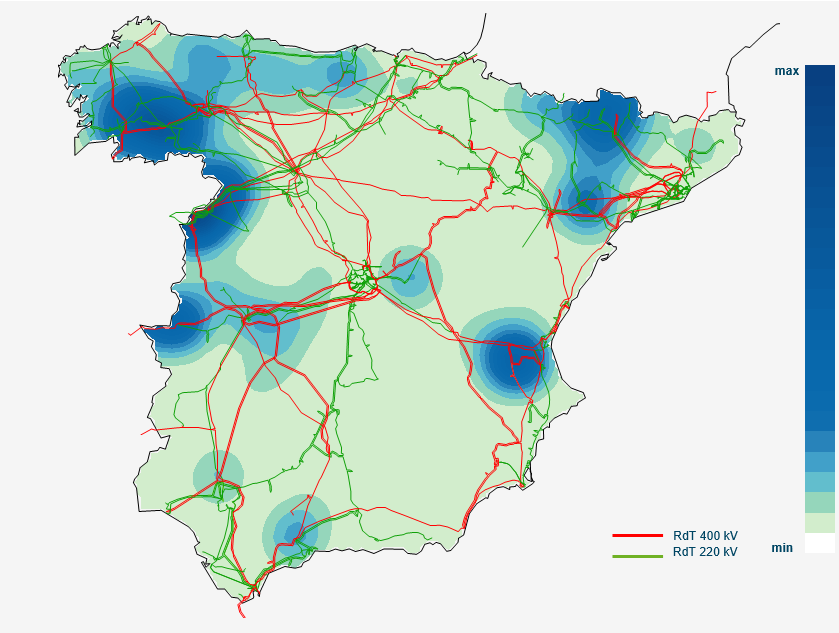
Hydroelectric power in each autonomous community as a share of national hydroelectric power
Energy from water
International comparison
Energy from water
Generation

Energy from wind
Installed capacity

Energy from sun
Photovoltaic solar